
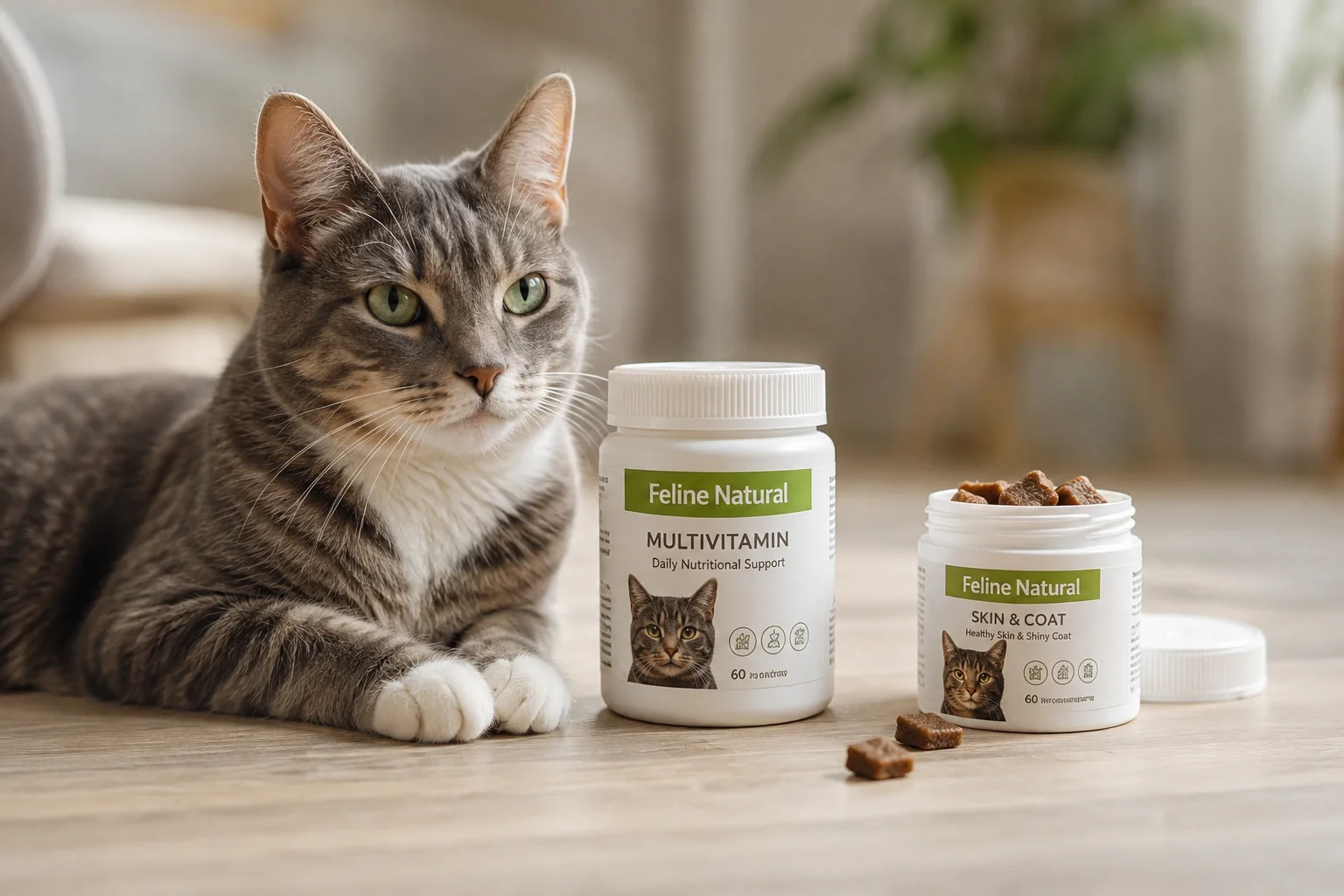
A dog will limp and let you know. A cat just stops doing the thing that hurts, so quietly that you never catch the moment it stopped. That instinct to hide weakness is ancient and hard-wired, and it makes caring for a cat a different job entirely. By the time a problem looks obvious, it has often been building for months. So good feline supplements begin not with a bottle, but with paying closer attention to a cat who would rather you didn't.
Why Cats Make Their Own Health So Hard to Read
Cats are both hunters and prey, and prey cannot afford to look vulnerable. A cat in pain grooms less, jumps a little lower, and slips off to a quieter corner — all without a sound. Owners rarely watch a decline happen. They notice a cat that has turned “calmer” or “lazier” with age, when the real story underneath is often stiffness or quiet discomfort.
Most of us spot these things only in the still part of the evening, once the house settles. That is often when we catch up with ourselves too — a book, a series, or a relaxed round at yetizino casino while the cat curls up nearby. In that quiet, the small changes surface: the shelf she no longer reaches, the way he lands more carefully than he once did.
Turning Quiet Signals Into a Shortlist of Feline Supplements
Once you start watching, the goal is not to buy everything. It is to turn a few honest observations into a short, sensible list. A cat rarely needs a cupboard of bottles. It needs one or two kinds of support, matched to what you have actually seen and given enough time to work.
Linking a specific behaviour to the support that tends to fit it makes the shelf far less confusing:
- Hesitating before a jump points toward joint support
- Stiffness after long naps suggests arthritis-focused care
- Loose or irregular digestion invites probiotic support
- A dull, flaky coat calls for an omega-rich skin blend
- Poor appetite during stress or change may ease with gut support
- General slowing in an older cat rewards steady daily support
A supplement is worth giving when it answers a question your cat's body is already asking. If you cannot name that question, you are buying reassurance for yourself, not help for the cat.
With the list short and the reason clear, the choice becomes calmer — and usually cheaper.
Joints Arthritis and the Slow Slide Owners Miss
Joint trouble is the classic hidden decline. Arthritis is far more common in older cats than most owners expect, yet it hides in plain sight because cats adapt so smoothly. Feline joint supplements and feline arthritis supplements are built for exactly this slow slide. They offer steady, everyday support rather than a dramatic fix, and they suit the cat whose world has quietly shrunk to the floor and the lower shelves.
Because the signs are subtle, it helps to know what to watch for and what patient support looks like over time.
| What you notice | Possible link | What steady support looks like |
|---|---|---|
| Fewer high jumps | Aching joints | A cat willing to climb again |
| Careful, stiff landings | Joint wear | Smoother, easier movement |
| Less grooming at the back | Reduced flexibility | A tidier, better-kept coat |
| Sleeping more than before | General discomfort | More time awake and curious |
| Reluctance on stairs | Arthritis | A steadier, more confident gait |
None of this shifts overnight. Joint care works quietly, over weeks, and the reward is a cat that slowly reclaims a little of the height it gave up.
With cats, the absence of a complaint is not the absence of a problem. Treat a change in habit as information, not personality.
Gut Health and the Case for Probiotic Support
Digestion is the other place cats struggle in silence. A sensitive stomach, a diet change, or a course of medication can tip the gut off balance, and the signs are easy to write off as “just a fussy cat.” Feline probiotic supplements support the good bacteria that keep digestion steady. That matters more than many owners realise, because so much of a cat's overall condition traces straight back to the gut.
Probiotics are not an overnight remedy, so honest expectations keep you from giving up too soon.
| Timeframe | What is realistic | What to avoid |
|---|---|---|
| First few days | Cat adjusts to the taste | Mixing into a full, cold meal |
| First two weeks | Digestion begins to settle | Stopping at the first good day |
| Three to four weeks | Steadier, firmer stools | Switching brands too quickly |
| Beyond a month | A calmer, more regular gut | Expecting a cure for every upset |
A settled gut rarely announces itself. You simply notice, one week, that the litter box has stopped being a worry.
Choosing the Best Feline Supplements Without the Guesswork
The best feline supplements are not always the ones with the softest packaging or the warmest story. The front of a bottle is built to reassure you. The back is where the honesty lives. When two products look alike on the shelf, the details underneath usually separate real help from a pleasant waste of money.
Before you buy, check a few plain markers that trustworthy brands are happy to state:
- Named ingredient sources rather than a vague “blend”
- Active amounts listed clearly per serving
- Doses written for a cat's size, not scaled down from a dog
- Third-party testing for purity and freshness
- Formulas made specifically for cats, not repackaged human products
- A short ingredient list without needless filler
Cats process nutrients differently from people and dogs, so a product built for them is not a marketing detail. It is the whole point.
Caring for a cat is mostly an act of attention. The animal will not tell you when a joint aches or a stomach unsettles, so the watching falls to you. Notice the jump not taken and the shelf left unused, match one honest observation to one well-made formula, and give it unhurried time. Do that, and a quiet daily habit can support the joints, the gut, and the easy comfort of a cat who trusts you to notice what it will never say.